About dyslexia
What to know about dyslexia.
A common, lifelong difference in how the brain processes language. It is not linked to intelligence, and with the right support people thrive.
Overview
A different way of processing language.
Dyslexia is a learning difference that affects the way the brain processes language. People with dyslexia may experience challenges with decoding, reading fluency and comprehension, but dyslexia is not linked to intelligence, and it affects people of all ages and backgrounds.
It is a neurodevelopmental difference that is present from birth and often runs in families. Research suggests it results from differences in brain structure and function that affect how written and spoken language is processed.
Dyslexia is lifelong, but with the right support, individuals develop effective strategies and thrive in school, at work and in life. Early identification and intervention make the biggest difference.
- 1 in 5
- people have dyslexia to some degree
- 15–20%
- of the global population, one of the most common learning differences
- Lifelong
- and not linked to intelligence. With support, people thrive
Signs of dyslexia
What to look for.
In children
- Difficulty learning nursery rhymes, playing rhyming games and forming words correctly
- Difficulty with phonemic awareness: recognising and working with sounds in speech
- Difficulty with letter and word recognition and with decoding
- Difficulty with spelling and written expression
- Slow reading speed and fluency
- Difficulty with comprehension and following instructions
- Problems remembering sequences; difficulty with maths and sequencing
- Mixing up words, e.g. “tired” for “tried”, “bread” for “beard”
- Avoiding reading, or using work-avoidance tactics
- Excessive tiredness from the effort and concentration required
In adults
- Difficulty with reading and spelling; slow reading speed
- Difficulty with word retrieval and grammar
- Difficulty with time management and organisation
- Difficulty with written tasks and following written instructions
- Confusing left and right, up and down, east and west
- Knowing more than they can put on paper
- Finding a list of instructions hard to hold in memory, but managing each task when told individually
- Dreading writing memos or letters; finding it hard to summarise a story
- Confusing upper- and lower-case letters
Not every person with dyslexia shows all of these signs, and adults may have developed coping strategies that mask them. These lists are not a diagnosis. If you have concerns, seek an assessment from a qualified professional.
Myths & facts
Common misconceptions.
Misunderstanding fuels stigma. Here’s what the evidence says.
Myth Writing letters backwards is a sign of dyslexia.
Fact: Many young children reverse letters while learning to read and write, and a child can be dyslexic without reversing letters. Dyslexia is a language-processing difference in connecting speech sounds with written letters.
Myth Dyslexia can be outgrown.
Fact: Dyslexia is lifelong. Early intervention and support make the journey successful, though even accurate readers may continue to read more slowly.
Myth People with dyslexia are lazy.
Fact: They are not. Their brains often work much harder to read and write than others’, which can lead to tiredness and frustration.
Myth People with dyslexia are not intelligent.
Fact: Dyslexia is not related to intelligence. Many dyslexic people are gifted and at the top of their fields.
Myth Dyslexia only affects boys.
Fact: Girls are just as likely as boys to have dyslexia.
The positive side
Dyslexia brings real strengths.
Creativity
A unique way of looking at the world, often with gifts in art, music and design.
Problem-solving
Thinking outside the box to find innovative solutions.
Interpersonal skills
Often highly empathetic and attuned to people and social cues.
Resilience
Working harder to read and write builds perseverance that pays off everywhere.
Big-picture thinking
Seeing connections and the whole picture, not just the details.
Among the many people with dyslexia
- Dentaa Amoateng MBE
- Archbishop Duncan-Williams
- Okyeame Kwame
- Nana Anash Kwao IV
- Rosalin Abigail Kyere-Nartey
- Joy Thomas
- Richard Branson
- Keira Knightley
- Lewis Hamilton
- Steven Spielberg
- Whoopi Goldberg
- Magic Johnson
How to help
Everyone has a part to play.
Schools & educators
- Screen early for dyslexia and other learning differences
- Use multi-sensory teaching and explicit phonics instruction
- Provide accommodations such as extra time and assistive technology
- Create individualised education plans (IEPs)
- Train teachers and staff on learning differences
- Build classrooms that celebrate every learner’s strengths
Parents & caregivers
- Learn about dyslexia and how to support your child
- Advocate for screening, intervention and accommodations at school
- Focus on strengths and build self-esteem
- Read together one-to-one; use audiobooks and assistive technology
- Seek outside support such as tutoring or therapy
- Talk openly with your child about dyslexia
Employers
- Foster a workplace culture that values neurodiversity
- Offer text-to-speech and speech-recognition tools
- Allow extra time, flexible arrangements and quiet workspaces
- Share written materials in dyslexia-friendly formats
- Provide dyslexia awareness training
- Recognise the strengths dyslexic employees bring
Governments
- Mandate early dyslexia screening in schools
- Invest in teacher training on dyslexia-inclusive education
- Ensure access to accommodations in schools and public institutions
Need guidance or a referral for assessment? Email info@africadyslexia.org, or join us at ADC 2027.
20–22 Oct 2027 · Accra
Awareness got us here.
Action takes us further.
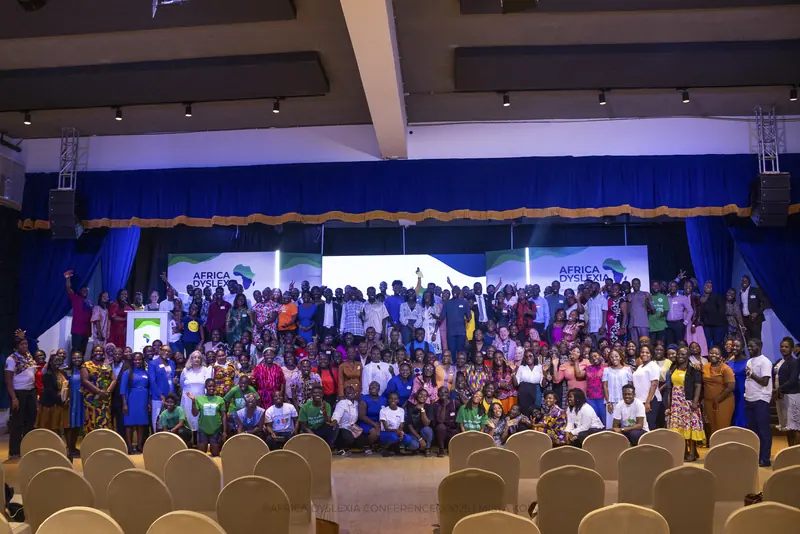
Delegates at the close of ADC 2025